
Most clinics publishing prices in 2026 charge $750 to $1,200 for a single Morpheus8 session on the face, and $2,500 to $3,000 for a package of three. Smaller areas such as the eyes or part of the face start around $470 to $650. Body areas such as the abdomen, arms or thighs run $850 to $1,250 per session depending on the size of the area.
Two things are worth knowing before you start comparing quotes. First, the advertised “starts at” price is routinely two to three times below what a face treatment actually costs at the same clinic. Second, in October 2025 the FDA issued a safety communication about radiofrequency microneedling that named burns, scarring, fat loss, disfigurement and nerve damage among reported complications, and stated plainly that RF microneedling is a medical procedure rather than a cosmetic treatment. That changes how you should think about a cheap quote.
Here is what the evidence actually shows.
What clinics published in 2026
These are prices taken from clinics’ own published rate information, not from surveys or aggregators.
| Clinic | City | Single session | Package of three |
|---|---|---|---|
| Med Aesthetics Miami | Miami, FL | $1,000 face and neck | $2,500 |
| SYRA Aesthetics | New York, NY | $1,100 | $2,970 |
| Miami Skin Spa | Miami, FL | $975 face and neck | $2,500 |
| Mirror Mirror Med Spa | Los Angeles, CA | $835 face and neck | $2,499 |
| Bloom Plastic Surgery | Chicago and Hinsdale, IL | From $940 | From $2,628 |
| Tribeca MedSpa | New York, NY | From $750 | Not published |
| Mara’s Med Spa | Dallas, TX | $750 to $1,200 | About $2,800 |
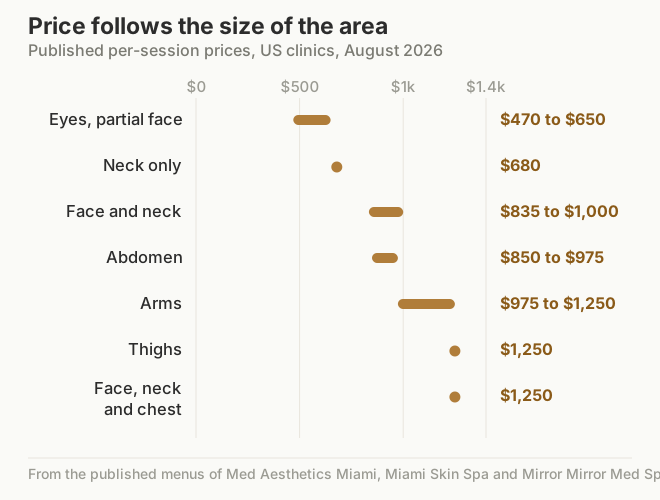
Two of these clinics publish a full per-area menu. Med Aesthetics Miami lists eyes $470, neck only $680, face and neck $1,000 and body $1,100, with three-session packages at $1,155, $1,800, $2,500 and $2,800 respectively. Miami Skin Spa lists partial face $650, face or lower face and neck $850, face and neck $975, face, neck and chest $1,250, lower abdomen $850, full abdomen $975, one arm $975, full arms $1,250 and inner or outer thighs $1,250. Bloom Plastic Surgery splits its offering by intensity instead, with a lighter “Mini Morpheus” from $524 (three for $1,332) and a standard treatment from $940.
One caution about published prices generally: they are not always internally consistent. Med Aesthetics Miami’s treatment-cost page lists face and neck at $1,000, while a separate page on the same site describes facial treatments as “typically” $600 and ranging $500 to $900. Both are that clinic’s own published copy. When you get a quote, ask which page it came from.
Why “average cost” figures are less useful than they look
You will see a national average of $1,861 quoted widely. That figure comes from RealSelf and is based on 124 patient-reported prices. RealSelf’s page was last updated in May 2024, and its state and metro breakdowns are explicitly labeled as data from July 2023. For a 2026 decision, that is a three-year-old, self-reported, small-sample number.
The American Society of Plastic Surgeons, which is the usual authority for procedure costs, does not publish an average for microneedling or RF microneedling at all. The word microneedling does not appear in its 2024 statistics report. The closest ASPS category is “nonsurgical skin tightening”, at an average surgeon fee of $2,326 in 2023, but the procedures ASPS names in that category are Pelleve, Thermage and Ultherapy, none of which are RF microneedling devices. Morpheus8 is not in that basket, and you should treat anyone quoting $2,326 as the Morpheus8 average as having misread the source.
ASPS also notes that its average fee “is only part of the total price” and excludes facility costs and anesthesia fees.
What you are actually paying for: area and depth
Price tracks two variables far more closely than it tracks anything else.
Treatment area. Larger surfaces cost more, and the progression is consistent across clinics. Using Med Aesthetics Miami’s published menu as an example: eyes $470, neck $680, face and neck $1,000, body $1,100. Miami Skin Spa’s menu shows the same slope on the body: lower abdomen $850, full abdomen $975, one arm $975, full arms $1,250.
Depth and tip. This is the distinction most price comparisons miss. Morpheus8 uses several different tips at different depths. Per InMode’s own published specifications, the resurfacing tip works at 0.5mm to 0.75mm, the 24-pin facial tip reaches up to 4mm to 5mm, and the Body tip reaches up to 7mm, which InMode describes as an 8mm thermal profile once the additional 1mm of heat spread is counted.
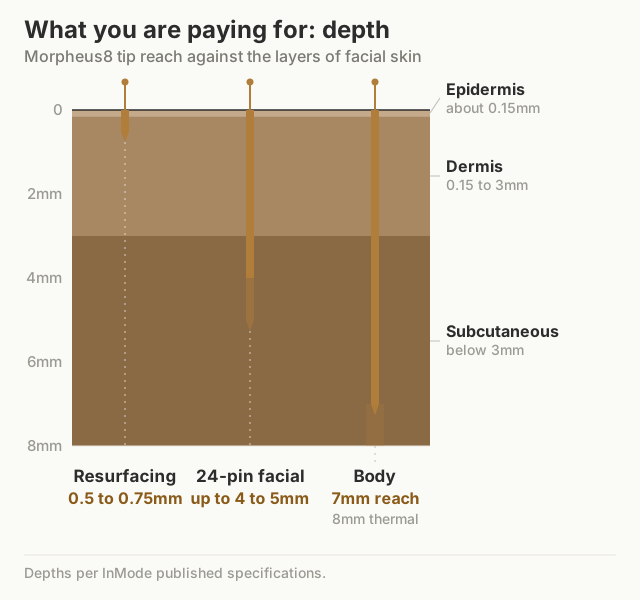
More aggressive treatment needs more anesthesia, takes longer and costs more. Bloom Plastic Surgery prices this explicitly: its “Mini Morpheus” starts at $524 and uses lighter numbing, while its standard Morpheus starts at $940 and may involve nerve blocks, Pro-Nox analgesic gas or injectable lidocaine. That is a 1.8x price difference on the same device.
Bloom is careful about why. It attributes the gap to lower settings, fewer passes and less numbing on the Mini, and to who performs it: a staff provider does the Mini, the practice’s surgeon does the standard. Depth is one input into that, not the whole of it. The useful lesson is that “same device” does not mean same treatment, and the price gap is usually telling you something real about intensity, time and who is in the room.
When a quote seems low, ask which tip, what depth, how many passes and who is holding the handpiece. It is frequently the answer.
This is also the main thing separating Morpheus8 from standard microneedling, which uses needles alone with no radiofrequency energy and sits at a much lower price point.
Sessions, packages, and when a package is not a discount
Recommendations cluster tightly. RealSelf reports that two to three sessions are usually recommended initially. Clinics we checked recommend between one and four, most commonly three, spaced four to six weeks apart.
Package discounts vary far more than you would expect:
- Med Aesthetics Miami: $2,500 for three versus $3,000 individually, about 17 percent off
- Miami Skin Spa: $2,500 for three face and neck sessions versus $2,925, a stated saving of $425
- Bloom: $1,332 for three Mini sessions versus $1,572, about 15 percent off
- SYRA: $2,970 versus $3,300, which is 10 percent, and the page states it saves $330
- Mirror Mirror: $2,499 for three versus $2,505 individually, a saving of six dollars
That last one is worth internalizing. A “package” is a pricing structure, not automatically a discount. Do the multiplication yourself.
It also shows where discounts actually come from. Mirror Mirror is separately advertising 20 percent off treatment packages, which is worth several hundred dollars, against the six dollars the package structure itself saves you. The promotion is the discount. The package is just how the price is bundled, and promotions come and go, so confirm what is running on the day you book.
RealSelf also notes that many providers charge by the individual session rather than offering packages at all, so ask directly whether a multi-session price exists before you assume one does.
Does it cost more in New York? Less than you would think
The intuitive answer is yes, and the most-cited dataset agrees: RealSelf’s July 2023 metro averages put New York City at $3,625 and Miami at $3,115, against Dallas-Fort Worth at $1,400 and Atlanta at $1,433, a 2.6x spread.
The 2026 clinic-published prices do not reproduce that. New York clinics publish $750 starting and $1,100 per session. Los Angeles publishes $835. Dallas publishes $750 to $1,200. Chicago publishes from $940. Miami publishes $975 and $1,000 for face and neck at two different clinics.
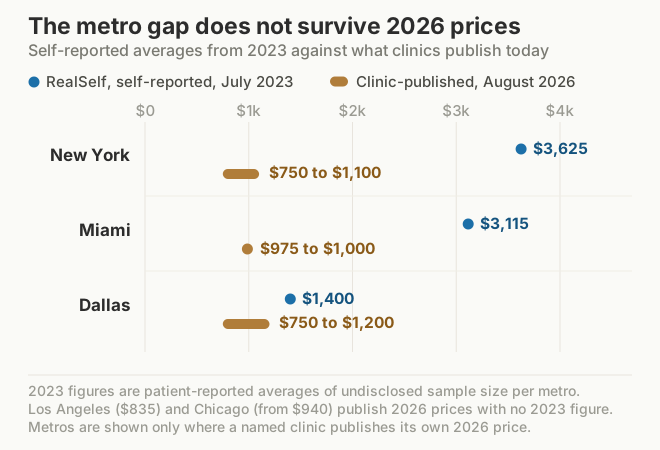
Those numbers overlap almost completely. The honest reading is that RealSelf’s metro spread rests on self-reported data of undisclosed and probably small per-metro sample size, and that in 2026 provider tier and treatment depth drive price more than your zip code does. Do not assume you will save money by driving to a smaller market, and do not assume a New York clinic is overcharging because it is in New York.
What the FDA cleared, and what it did not
This matters for evaluating claims, and it is frequently stated incorrectly.
Morpheus8 is FDA-cleared, not FDA-approved, through the 510(k) pathway as a Class II device. The relevant clearances include K200947 (cleared July 2, 2020), K231790 (July 20, 2023), K240017 (June 13, 2024) for the Morpheus8 90 Applicator, and K242598 (November 14, 2024) for the DEFINE System including the Morpheus8 applicator. All sit under 21 CFR 878.4400, “Electrosurgical cutting and coagulation device and accessories”.
The cleared indication, in the FDA’s own wording on the more recent letters, is for use “in dermatologic procedures where coagulation/contraction of soft tissue or hemostasis is needed.” A restriction appears on every one of them: at energy levels above 62 mJ per pin, use is limited to Skin Types I to IV.
Morpheus8 is not FDA-cleared for “skin tightening”, “wrinkle reduction”, “cellulite”, “fat reduction” or “body contouring” as such. The FDA’s general guidance on microneedling devices states they are authorized to improve the appearance of facial acne scars, facial wrinkles and abdominal scars in patients aged 22 or older. If a clinic’s marketing promises a result outside those terms, that promise is the clinic’s, not the FDA’s.
This distinction is worth carrying into any consultation about sagging skin, fine lines and wrinkles or acne scars, which are the three concerns Morpheus8 is most often marketed against.
The October 2025 safety communication
On October 15, 2025, the FDA issued a safety communication titled “Potential Risks with Certain Uses of Radiofrequency (RF) Microneedling”. It is the single most important document to read before choosing a provider on price.
The FDA reported serious complications including burns, scarring, fat loss, disfigurement and nerve damage, some requiring surgical repair or medical intervention. It stated that “RF microneedling is a medical procedure, not a cosmetic treatment, and these devices should not be used at home”, and recommended that patients seek care from a licensed health care provider with training and experience on the use of RF microneedling devices, and ask which devices the provider plans to use.
Separately, the FDA’s standing guidance on microneedling devices tells patients to ask whether a new microneedle cartridge is used for each patient and for each session with the same patient. Its wording is unambiguous: re-use of the needle cartridge “is unsafe and is not consistent with the FDA’s review and authorization, even if the cartridge is cleaned.” The matching instruction to providers is not to reuse a cartridge or use one on more than one patient, because it could transfer infectious agents. It is a fair question to ask at a consultation, and a clinic that treats it as an odd one has told you something.
The American Academy of Dermatology responded the following day, October 16, 2025, recommending patients consult a board-certified dermatologist.
More routine effects are well documented in the clinical literature. A 2021 systematic review in the Journal of Clinical and Aesthetic Dermatology found that with fractional RF microneedling, erythema generally lasts from 12 hours to three to five days, edema lasts up to 12 hours or in some cases a few days, and pinpoint bleeding has been reported for up to a week. The review also recorded rare events including tram-track scarring in two patients and one case of numbness lasting three weeks.
None of this means the treatment is unsafe in trained hands. It does mean that the difference between a $524 quote and a $1,100 quote may be the difference in who is holding the handpiece, and that is not a place to economize blindly.
Who is legally allowed to perform it
This varies by state to a degree that surprises most patients, and it is directly relevant to price.
- California: the Board of Barbering and Cosmetology stated in a June 5, 2014 industry bulletin that microneedling and derma rolling is “not within the scope of practice for any Board licensee”. An esthetician cannot legally perform it.
- Nevada: the State Board of Nursing’s aesthetic practice decision, approved January 17, 2025, sets tiers by depth. Microneedling under 0.5mm may be performed by RNs and LPNs under direct supervision; from 0.5mm to 1.5mm and above, RNs only, LPNs not within scope. Radiofrequency procedures generally require direct supervision for RNs.
- North Carolina: the Board of Nursing permits RNs to perform cosmetic dermatological procedures as ordered by a physician or other prescriber, and explicitly does not require the on-site presence of a physician. LPNs do require on-site supervision.
- Texas: the Medical Board’s rules treat use of a prescription medical device for cosmetic purposes as a nonsurgical medical cosmetic procedure, requiring prior physician or midlevel evaluation, and either an on-site practitioner or a delegating physician available for emergency consultation.
There is no single national rule. Ask who will perform your treatment, what their license is, and whether a physician is on site. In some states that answer is a legal requirement; in others it is a choice the clinic has made.
Costs that are not in the headline price
- Numbing and anesthesia. Sometimes included, sometimes billed, and it scales with how aggressive the treatment is. Bloom Plastic Surgery’s standard Morpheus may involve nerve blocks, Pro-Nox analgesic gas or injectable lidocaine, where its lighter Mini does not.
- Add-on treatments. Often presented at the same appointment. Miami Skin Spa publishes exosomes at $300 and a CO2 Lift mask at $99 alongside its Morpheus8 menu.
- Consultation. Frequently free, sometimes charged, sometimes non-refundable but credited against treatment if you book within a set window. Ask which applies before you book.
- Deposits and cancellation fees. Common, and often non-refundable inside a 24 hour window. Get the policy in writing.
- Maintenance. Results are not permanent, and touch-ups are usually discussed at six to twelve month intervals. Expect them to be priced as a single session at whatever that clinic charges.
- Insurance. Morpheus8 is elective and cosmetic. It is not covered.
A note on financing
Most clinics offer third-party financing. Cherry, CareCredit and PatientFi appear repeatedly on clinic pages, sometimes advertised as 0% APR for six to twelve months.
Read the deferred-interest terms carefully. The Consumer Financial Protection Bureau reported on May 4, 2023 that medical credit cards carry interest rates reaching 26.99%, against about 16% for a general-purpose credit card. Consumers used these products for nearly $23 billion in healthcare between 2018 and 2020 across more than 17 million purchases, and paid $1 billion in deferred interest charges alone. The CFPB’s concern with deferred interest plans is that all accrued interest can become due at the end of the promotional period.
There is enforcement history here too. In December 2013 the CFPB ordered GE CareCredit to fund a $34.1 million reimbursement for more than 1.2 million consumers, finding that some were misled during enrollment about the terms of a deferred-interest loan carrying a 26.99% APR. That enrollment happened at the point of sale, in provider offices.
The CFPB’s 2023 report addresses medical care generally rather than elective cosmetic procedures specifically. The mechanics of deferred interest are the same either way.
Questions to ask before you pay a deposit
Take this to your consultation
Six questions before you pay a deposit
- Which tip and what depth, and does the quoted price change if you go deeper?
- Is this per session or for a package, and what is the per-session price if I only do one?
- Who will perform the treatment, what is their license, and is a physician on site?
- Is numbing included in this price?
- What is your deposit and cancellation policy in writing?
- Given my skin type, what energy level do you plan to use? Above 62 mJ per pin, the clearance is limited to Skin Types I to IV.
AuraVenu · auravenu.com
Before you book
Morpheus8 is a medical procedure delivered by a device with a specific, narrow FDA clearance, and the FDA has documented serious complications from RF microneedling within the last year. Choose the provider first and the price second. If you have a history of keloid scarring, active skin infection, or you are pregnant, discuss it with a physician before booking. Any burning, spreading redness, blistering or numbness after treatment warrants prompt medical attention rather than waiting for a follow-up appointment.
If you are still deciding between treatments, our comparison of HydraFacial and microneedling covers the gentler end of the same spectrum.
Every price in this guide was read from the named clinic’s own published pages and re-checked on August 10, 2026. Where a clinic’s pricing could not be confirmed on its own site, it was left out rather than estimated. Clinic pricing changes frequently, promotions come and go, and the figures above are examples of what specific named clinics publish, not a quote for your treatment.
Find verified Morpheus8 providers near you
Sources
- FDA, Potential Risks with Certain Uses of Radiofrequency (RF) Microneedling, Safety Communication, October 15, 2025
- FDA 510(k) clearance records K200947, K231790, K240017 and K242598
- American Academy of Dermatology, statement on the FDA safety briefing about radiofrequency microneedling risks, October 16, 2025
- Gowda A, Healey B, Ezaldein H, Merati M. “A Systematic Review Examining the Potential Adverse Effects of Microneedling.” J Clin Aesthet Dermatol. 2021;14(1):45-54
- American Society of Plastic Surgeons, 2023 average surgeon and physician fees; 2024 procedural statistics
- CFPB, Medical Credit Cards and Financing Plans, May 4, 2023
- CFPB, enforcement action against GE CareCredit, December 10, 2013
- California Board of Barbering and Cosmetology, industry bulletin on microneedling and derma rolling, June 5, 2014
- Nevada State Board of Nursing, Aesthetic Practice Decision, approved January 17, 2025
- FDA, Microneedling Devices, cleared indications, risks and cartridge re-use guidance
- Clinic pricing pages, read August 10, 2026: Med Aesthetics Miami, SYRA Aesthetics, Miami Skin Spa, Mirror Mirror Med Spa, Bloom Plastic Surgery, Tribeca MedSpa, Mara’s Med Spa
- RealSelf, Morpheus8 cost page (updated May 2024; metro data as of July 2023)
- InMode, Morpheus8 technical specifications and press releases
- North Carolina Board of Nursing, position statement on cosmetic and aesthetic dermatological procedures, revised September 2022
- Texas Administrative Code 22 TAC section 193.17