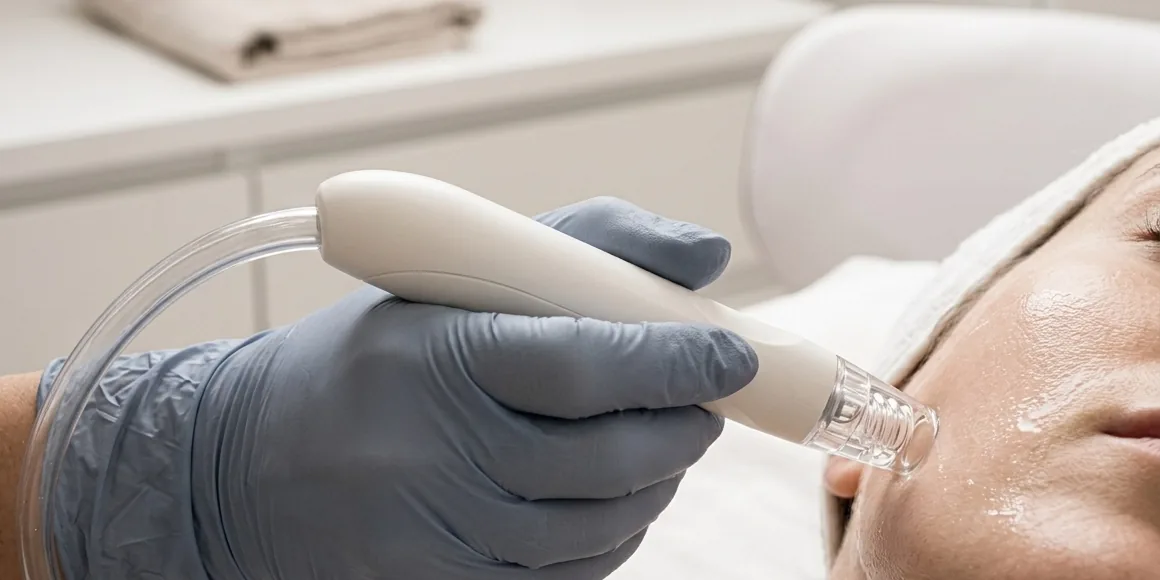
Microneedling creates tiny controlled injuries that can improve the appearance of scars and skin texture as the skin heals. It is also sold with a lot of add-ons, some with better evidence than others. Knowing the difference can help you decide what is worth discussing at a consultation.
This guide covers how it works, what the research supports and where it is thin, how the radiofrequency and PRP versions compare, sessions and downtime, who should not have it, and what clinics charge in 2026. If you are weighing it against a HydraFacial, that comparison is here.
How microneedling works
A microneedling pen with a sterile, single-use cartridge of fine needles makes thousands of tiny punctures in the skin at a set depth. Each puncture is a controlled injury, and the skin responds the way it responds to any wound: inflammation, new tissue, then remodeling, which includes new collagen and elastin. Dermatologists call the technique percutaneous collagen induction.
Depth is one important variable. Pens typically adjust from about 0.5 mm to 2.5 mm; shallower settings target texture and fine lines, deeper settings reach the dermis where acne scars sit. The first device the FDA cleared, SkinPen Precision, was initially cleared in 2018 for facial acne scars at depths up to 1.5 mm, and its review documents note that safety at greater depths “has not been evaluated.” That is a statement about that clearance, not a depth limit for every device. Your clinician should follow the current instructions for the exact device and treatment area.
Because it uses no heat or light, standard microneedling does not target pigment, which is why it is a common choice for darker skin tones, where lasers carry a higher risk of post-inflammatory hyperpigmentation. In one split-face trial in skin of color, hyperpigmentation followed 30 percent of fractional CO2 laser treatments and 6.7 percent of microneedling treatments. That comparison does not mean the risk is zero, or that it applies to every laser or RF device.
What the FDA has and hasn’t cleared
The FDA regulates microneedling devices intended to penetrate living skin for medical or aesthetic treatment. Clearance is specific to a device and its intended use. The FDA has cleared devices for adults 22 and older to improve the appearance of facial acne scars, wrinkles around the eyes and elsewhere on the face and neck, and abdominal surgical scars. SkinPen’s first clearance, in March 2018, was for facial acne scars; in its small pivotal study, 11 of 20 treated patients showed improvement at six months.
Two limits matter when you read a clinic’s menu. The FDA has not cleared microneedling devices to deliver PRP, cosmetic serums or exosomes into the skin, or to treat hair loss. A manufacturer-specified glide gel supplied with a device is different from adding another treatment product. Short, blunt at-home rollers intended only to exfoliate do not have the same medical-device clearance.
What it helps, and how strong the evidence is
Acne scars are the main focus of microneedling research and an FDA-cleared indication for certain devices. The American Academy of Dermatology cites studies in which three to five treatments, spaced two to four weeks apart, improved the appearance of acne scars by 50 to 70 percent. Those are study findings, not a promise of an individual result.
A 2016 Cochrane review found that acne scar trials were often small and at high risk of bias, so it could not support any one treatment as the first choice. It found evidence that injectable filler can help some depressed scars compared with placebo, but did not show filler to be better than the other options overall. Your scar type, skin and goals should guide the options you discuss with a dermatologist.
Fine lines and sun damage. Skin texture may improve after a course. A 2021 review of 25 published studies found only four that specifically examined wrinkles and described the literature as limited and mostly low quality. Expect gradual changes rather than a guaranteed degree of improvement.
Melasma. Microneedling is not a first-line melasma treatment on its own. Research has examined combining it with topical tranexamic acid: a 2024 systematic review of 12 studies reported promising results, but the studies used different methods and longer-term benefit remains uncertain. Melasma can worsen with sun and irritation, so discuss the options with a dermatologist rather than choosing an add-on from a treatment menu.
Enlarged pores, stretch marks and surgical scars are also discussed as possible treatment targets, but the published data, for pores especially, is thin. Ask what evidence supports the specific concern and device being proposed.
Standard, RF, PRP and exosomes: what’s actually different
Standard microneedling uses needles without RF heat, sometimes with the glide product specified in the device’s instructions. That accessory is not a reason to use an unrelated serum during treatment. The sections above mainly concern standard microneedling.
Radiofrequency (RF) microneedling (Morpheus8, Potenza, Vivace, Secret RF and others) adds heat: the needles deliver radiofrequency energy into the dermis as they go in, a thermal injury on top of the mechanical one. It is marketed for tightening, laxity and deeper scars, and it reaches further; Morpheus8’s clearance documents list depths up to 4 mm with the facial tip and 7 mm with the body tip.
Three things to know. FDA clearance depends on the device. Morpheus8 is cleared for soft-tissue coagulation and contraction, which does not establish every marketed cosmetic benefit, and the clearance limits its highest energy settings to Fitzpatrick skin types I to IV. The evidence is promising but young: a 2025 systematic review of 16 studies and 481 patients concluded RF microneedling is “likely” effective for acne scars and called for randomized trials, and the literature on tightening is mostly small studies and case reports.
On October 15, 2025 the FDA issued a safety communication reporting burns, scarring, fat loss, disfigurement and nerve damage with certain uses of RF microneedling, stating that “RF microneedling is a medical procedure, not a cosmetic treatment”; the dermatologic surgery and laser societies responded that it can be performed safely under a trained, board-certified physician. RF generally costs more than standard needling. The number of sessions and downtime depend on the device, settings, area and goal. Our Morpheus8 guide covers the device, the clearances and published prices in detail.
PRP (the “vampire facial”) means a small amount of your blood is drawn, spun to concentrate the platelets, then applied or injected as part of the treatment. The aim is to support healing. A meta-analysis published in 2022 included 14 studies and 472 patients and found better acne scar outcomes when PRP was added. The studies were small and varied, and the comparison treatments were not always microneedling alone. Limited side-effect reporting cannot establish that PRP adds no risk. PRP can add to the session cost; the price examples below show how much this varies.
Because it involves blood, infection control is essential. In 2024, the CDC reported a cluster of five HIV cases linked to an unlicensed New Mexico spa. Three infections were probably acquired through the spa; two appeared to predate the procedures, and one of those two people had never received spa services. Inspectors found unsafe blood handling and equipment practices. When considering PRP facial providers, ask about staff licensing, blood handling and single-use equipment. A licensed setting still needs sound infection-control procedures.
Exosomes are tiny particles released by cells. Some clinics offer exosome-based serums after microneedling, but these products vary in source and preparation.
There are no FDA-approved exosome products in the US. The FDA has warned about serious adverse events following injections of unapproved exosome products. That does not mean every topical serum carries the same risk. But applying a product after microneedling is different from using it on intact skin, and a cosmetic label does not establish its safety for this procedure.
A 2026 systematic review included eight small studies involving 171 patients. Early results were promising, but the studies used different products and methods and could not establish reliable long-term safety or effectiveness. For studies using externally prepared exosomes, the authors found that the regulatory status and ethical oversight of the supplying companies had not been disclosed. An add-on may cost hundreds of dollars, so ask the provider what is in the product, where it came from and what evidence applies to that specific use.
What a session looks like, and the downtime
Numbing cream goes on for 30 to 45 minutes, then the treatment takes 20 to 30 minutes for the face. You will feel pressure and a scratching or vibrating sensation; deeper passes over bony areas are the least comfortable, and pinpoint bleeding is normal at scar-treating depths. Afterward your skin is red and warm, like a sunburn. A good clinic opens a new, sealed cartridge for every patient and every session, and the FDA tells patients to ask about this directly.
The professional societies converge on a course rather than a single visit: the AAD says three to five treatments, two to four weeks apart, for acne scars; the American Society for Dermatologic Surgery says a series of monthly treatments, at least three. Expect some improvement within weeks and the full result over several months, because collagen remodeling continues long after the redness fades. Your clinician may suggest maintenance treatment, depending on the concern and how your skin responds.
Downtime is short but not zero. Redness and mild swelling can last a few days, with dryness and flaking afterward; the ASDS gives a range of two to seven days depending on depth. The AAD advises waiting at least 24 hours before makeup. Follow your clinician’s instructions on when to restart sunscreen and other products, and protect treated skin from the sun from the outset. Bleeding, bruising, tightness, itching and peeling can occur; less common problems include pigment changes, a cold-sore flare and infection. Contact your clinic promptly for worsening pain, spreading redness, pus, fever or a suspected burn rather than waiting for a routine review.
One avoidable complication deserves its own line. Needling can carry substances through the skin barrier. A 2014 report in JAMA Dermatology described three women with persistent inflammatory lumps after microneedling, with vitamin C serum implicated in the investigation. Use only the products specified for the device and your aftercare plan. Do not assume that your usual vitamin C, retinoid or other active serum is suitable immediately after treatment.
Who should not have microneedling
The American Academy of Dermatology advises against it for people who heal slowly or poorly, who have or have had a keloid, who have a weakened immune system from a condition or medication, who are being treated for skin cancer in the area, or who are receiving radiation. Treatment should wait if you have a recent tan or sunburn, a skin infection, active cold sores, or painful, pus-filled or deep pimples in the area; the ASDS adds that active acne should be controlled first.
Tell your provider if you have a bleeding disorder or take blood thinners, eczema or psoriasis in the treatment area, diabetes, or a history of cold sores (ask whether an antiviral beforehand is appropriate). Tell them if you are pregnant or breastfeeding; the FDA flags both as circumstances in which treatment may not be suitable. Do not stop prescribed blood thinners on your own.
On isotretinoin (Accutane), the advice is not uniform. The AAD says at least one month should pass after the last dose, while FDA patient guidance flags use during the previous six months. That difference is not a reason to choose the shorter wait yourself. Ask the dermatologist who prescribed it and the treating clinician to agree on timing for your skin, the procedure and the exact device instructions.
What microneedling costs in 2026
Microneedling is priced per session, usually with a package discount for three or four. On the day we checked, these clinics published the following on their own websites:
| Clinic | City | Standard microneedling (face) | With PRP | RF microneedling (Morpheus8) |
|---|---|---|---|---|
| New Horizons Med Spa | Chandler, AZ | $195 | Not listed | Not listed |
| Selfie House | New York, NY | $249 (4 for $799) | $499 (3 for $1,299) | $999 (3 for $2,499) |
| The Med Spa at St. Luke’s | Allentown, PA | $300 (3 for $800) | $1,000 PRP/PRF (3 for $2,500) | $1,000 (3 for $2,800) |
| Renuance Cosmetic Surgery & Medspa | Murrieta, CA | $300 to $600 | Not listed | $600 to $1,200 |
| InjectCo MedSpa | Dallas, Fort Worth, Austin and other TX locations | $399 (3 for $999) | From $799 (3 for $1,999) | Not listed |
| First Body | Alpharetta, GA | $400 | $700 | Not listed |
| Northwest Medical Arts | University Place, WA | $450 with growth-factor serum (3 for $1,200) | $700 (3 for $1,900) | Not listed |
| Skin Pharm | Atlanta, GA | $500 (3 for $1,350) | $600 (3 for $1,650) | Not listed |
| The Naderi Center | Chevy Chase, MD / Reston, VA | Not listed | $1,000 | $1,500 |
| Claytor Noone Plastic Surgery | Bryn Mawr, PA | Not listed | Not listed | $1,250 face or neck (3 for $3,250) |
Exosome add-ons were listed at $300 on one dermatology practice’s online store (advancederm.net) and as a $650 microneedling-with-exosomes session at Bella Santé in Boston.
Published cost estimates use different methods and may include different treatment plans. RealSelf’s patient-reported average for professional microneedling is $950 across 604 reviews, with single sessions from $200 to $800 and the PRP version averaging $830 (updated August 2023). CareCredit, citing a 2026 Synchrony cost study, puts the national average at $938 with a range of $686 to $1,515. The American Society of Plastic Surgeons publishes no microneedling average, so treat any “ASPS average” quoted for it with suspicion.
What moves the price: the device, the area, the add-on, the depth and who is holding the pen. A $195 session and a $600 session may be the same device at very different settings with different people operating it. Who is legally allowed to hold the pen also varies by state; California’s cosmetology board puts microneedling outside an esthetician’s scope, for example, while Nevada’s nursing board sets rules by needle depth. Our Morpheus8 guide has the state-by-state detail.
How to choose a provider
- Ask who performs it and what their license is. The AAD recommends a board-certified dermatologist. For any practitioner, check relevant training, authority to perform the procedure and the supervision required in your state.
- Ask which device and whether it is FDA-cleared. For RF, ask which device, at what settings, and whether it suits your skin type.
- Ask to see the sealed cartridge opened. One cartridge per patient per session, every time.
- Ask what goes on your skin during treatment. Check that the product is specified for the device or that the clinician can explain the evidence, regulatory status and risks of an off-label combination. “Sterile” alone does not establish suitability.
- Ask how they handle a cold-sore history, darker skin or recent isotretinoin. A clear answer should explain how the clinic assesses your skin and medical history before recommending treatment.
- Be realistic about add-ons. PRP has some supportive evidence for acne scars. Exosome research is early, and benefit and long-term safety are not established across products.
You can compare microneedling providers near you on AuraVenu, with ratings and the devices and add-ons each clinic lists.
For a fuller checklist, including how to look up a license and check that a device is FDA-cleared, see how to check a med spa is legitimate.
Frequently asked questions
Does microneedling hurt?
Numbing cream can reduce discomfort, but you may still feel pressure, scratching or stinging. Sensitivity varies by person, area and settings. RF adds heat and may need additional pain control. Ask your clinician how they will keep you comfortable and what to do if treatment feels too painful.
How many sessions do I need?
Three to five for acne scars, two to four weeks apart, according to the AAD. Texture may change after one or two, but the collagen response builds over months, so agree on a review point with your clinician before judging the final result.
Microneedling or Morpheus8?
Standard microneedling uses needles alone; Morpheus8 adds RF heat. They have different device indications, costs and risks. RF may be proposed for laxity or scars, but the FDA issued a safety communication about certain RF uses in October 2025. Ask a qualified clinician which approach, if either, fits your concern and skin type rather than assuming more heat means a better result.
Is PRP worth the extra cost?
For acne scars, some studies suggest an added benefit, but the size of that benefit and its value for the extra cost remain uncertain. Evidence is less established for general “glow.” Ask what improvement the clinician expects for you, what extra cost is involved and how blood handling is managed.
Can I microneedle at home?
At-home rollers are either too shallow to do what professional treatment does or, if they do puncture the skin, a way to spread infection and cause scarring. The AAD lists dermarolling among the skin-care trends to avoid.
Can I have microneedling if I’m on Accutane?
Do not book on the basis of a waiting period alone. The AAD advises at least one month after the last dose, while FDA patient guidance flags isotretinoin use in the previous six months. Your prescribing dermatologist and treating clinician should consider the exact device, your skin and healing before agreeing on timing.
Related guides
- HydraFacial vs microneedling: which is right for you?
- How much does Morpheus8 cost? 2026 price guide
- Morpheus8 for lipedema: what it can and can’t do
- How to check a med spa is legitimate before you book
- Find microneedling providers near you
This guide is general information, not medical advice. Whether microneedling is right for your skin, at what depth and with which add-ons, depends on your skin type, your history and what you are treating. Book an in-person consultation with a licensed provider before you decide.
Sources
- FDA, Microneedling devices: getting to the point on benefits, risks and safety, content current October 15, 2025; Regulatory considerations for microneedling products (guidance), November 2020
- FDA, Microneedling devices, content current October 15, 2025
- FDA, De Novo decision summary DEN160029, SkinPen Precision System, March 1, 2018; 510(k) K202243, SkinPen Precision System, April 2, 2021; 510(k) K200947, InMode Morpheus8, July 2, 2020; 510(k) K251254, InMode Ignite RF System with Morpheus8 applicators, January 15, 2026
- FDA, Potential risks with certain uses of radiofrequency (RF) microneedling: safety communication, October 15, 2025; ASLMS and ASDS, response to the FDA safety communication, December 8, 2025
- FDA, Public safety notification on exosome products, December 6, 2019
- American Academy of Dermatology, Microneedling can fade scars, uneven skin tone, and more, updated July 17, 2023; 5 unsafe skin care trends to avoid, 2023
- American Society for Dermatologic Surgery, Microneedling
- Cao AL, Sivesind TE, Abdel Hay R, Dellavalle RP. From the Cochrane Library: Interventions for acne scars. JMIR Dermatol. 2022;5(3):e37060, summarizing Abdel Hay R, et al. Cochrane Database Syst Rev. 2016;4:CD011946
- Cochrane, Treatment for acne scars, summary of the 2016 review
- Atiyeh BS, et al. Microneedling: percutaneous collagen induction (PCI) therapy for management of scars and photoaged skin. Aesthetic Plast Surg. 2021;45:296-308
- Olugbade ID, Negbenebor NA. The use of tranexamic acid and microneedling in the treatment of melasma: a systematic review. Cutis. 2024;114(2):E15-E23
- Agrawal K, et al. Fractional CO2 laser versus microneedling in atrophic acne scars in skin of color: a split-face study. Indian Dermatol Online J. 2024;15(6):942-948
- Kang C, Lu D. Combined effect of microneedling and platelet-rich plasma for the treatment of acne scars: a meta-analysis. Front Med. 2021;8:788754, published February 14, 2022
- Niaz G, et al. Fractional radiofrequency microneedling as a monotherapy in acne scar management: a systematic review. Clin Cosmet Investig Dermatol. 2025;18:19-29
- Panlilio M, et al. Radiofrequency microneedling and surgical facelifts: scoping review. JMIR Dermatol. 2026;9:e78385
- Dhaliwal NK, et al. The use of microneedling with exosomes in dermatology: a systematic review. J Cosmet Dermatol. 2026;25(4):e70881; also reported by Dermatology Times, April 29, 2026
- Soltani-Arabshahi R, et al. Facial allergic granulomatous reaction and systemic hypersensitivity associated with microneedle therapy for skin rejuvenation. JAMA Dermatol. 2014;150(1):68-72
- Spring LK, et al. Isotretinoin and timing of procedural interventions: a systematic review with consensus recommendations. JAMA Dermatol. 2017;153(8):802-809
- CDC, Investigation of presumptive HIV transmission associated with receipt of platelet-rich plasma microneedling facials at a spa, New Mexico, 2018-2023, MMWR 73(16), April 25, 2024
- RealSelf, How much does microneedling cost?, updated August 17, 2023; CareCredit, Microneedling cost, July 17, 2026
- Clinic price lists checked October 16, 2026: New Horizons Med Spa, Chandler AZ; Selfie House, New York NY; The Med Spa at St. Luke’s, Allentown PA; Renuance, Murrieta CA; InjectCo MedSpa, TX; First Body, Alpharetta GA; Northwest Medical Arts, University Place WA; Skin Pharm, Atlanta GA; The Naderi Center, Chevy Chase MD / Reston VA; Claytor Noone Plastic Surgery, Bryn Mawr PA; advancederm.net exosome add-on; Bella Santé, Boston MA